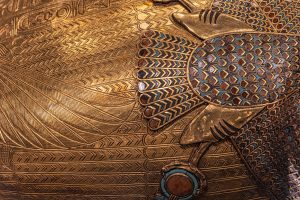
Cairo – The Greater Cairo metropolitan area is home to over 22 million people, making it the largest city in Africa. The Nile River, the longest river in Africa, flows directly through Cairo, shaping the city’s geography, dividing it, and supporting life in this desert climate.
Grand Egyptian Museum – The Grand Egyptian Museum is a national archaeological museum in Giza, Egypt. Dedicated to Egyptian civilization and its culture, society, and artifacts, the GEM is the largest museum in the world for a single civilization.
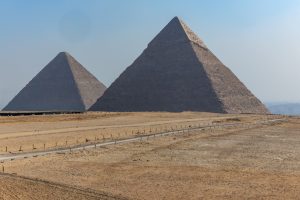
The Pyramids of Giza are a 4,500-year-old ancient Egyptian royal burial complex located on the Giza Plateau near Cairo, Egypt. It is the last surviving wonder of the original Seven Wonders of the Ancient World.
Saqqara is truly an open-air museum, one that has all of ancient Egyptian history on display. Kings and noblemen from the very first two dynasties (c. 3040–2686 BC) were buried here, and this is also the location of the Step Pyramid of Djoser (c. 2686–2667 BC).
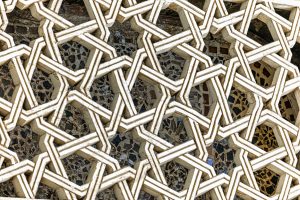
Islamic Cairo refers to the to the city’s rich history and heritage since its foundation in the early period of Islam. This area holds one of the largest and densest concentrations of historic architecture in the Islamic world.
Khan el Khalili bazaar, Egypt’s most famous and largest market dating back to the 14th century.
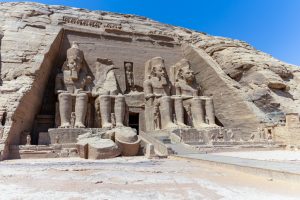
Constructed in the mid-13th century BC, Abu Simbel located near the border of Sudan was excavated from the sand in 1817. The temples were moved piece-by-piece from 1963 to 1968, where it sits today to avoid being lost due to the creation of modern Lake Nasser.
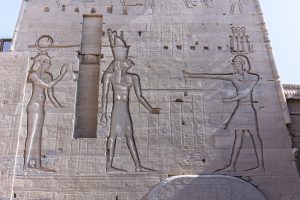
The Temple of Kom Ombo is an unusual double temple dedicated to Sobek the crocodile god, and Horus the falcon-headed god in the town of Kom Omboin southern Egypt. It was constructed during the Ptolemaic dynasty, 180–47 BC. Some additions to it were later made during the Roman period.
The Temple of Khnum in the town of Esna.
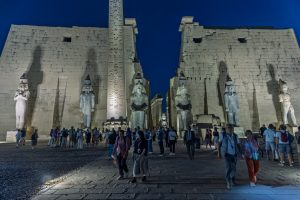
Luxor Temple, guarded by massive statues of Ramses II, with magnificent pylons, columns and statues.
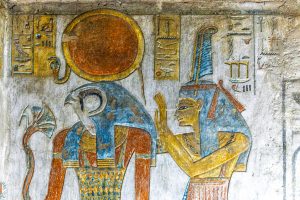
The Valley of the Kings is where the rulers of the Eighteenth, Nineteenth, and Twentieth Dynasties of Egypt’s prosperous New Kingdom (c.1550–1069 BC) were buried in a desolate dry river valley across the river from the ancient city of Luxor.
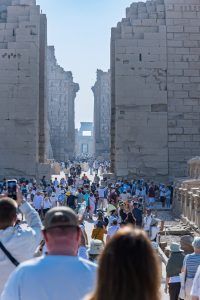
The Karnak Temple Complex, commonly known as Karnak comprises a vast mix of temples, pylons, chapels, and other buildings near Luxor, Egypt.